Teaching Elementary School Aged Students
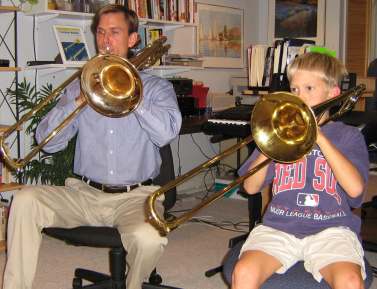
"Tom absolutely loves his lessons. You make a great difference in his life."
- Dottie Whitlock, Parent of a Middle School Trombone Student (formerly an Elementary School Student!)
"I cannot begin to tell you how much I appreciate all your years of dedication as Dan's trombone teacher. You were his first teacher, and the development and opportunities he has had with your guidance have been immeasurable and beyond my highest expectations. I am so glad he stuck with it all these years (9 and still counting), and that we were lucky enough to have you there as his teacher, role model, and friend, watching him grow from beginner to advanced player. You have always been positive and encouraging and I truly feel this has nurtured his love of the trombone and his confidence as a player."
- Chris, Parent of an Elementary through High School Student
"We can't say enough how much we appreciate Brian being our son's trombone teacher. Although we live in Newburyport, MA, we find the 2 hour round trip completely worth the travel time to have our son study with Brian. He is not only a professional and talented performer himself but a teacher totally dedicated to the skill of teaching. Brian approaches teaching in the most positive way, successfully acknowledging both his student's strengths while setting personal and continuous goals for improvement. Our son looks forward to his lessons dearly and finds the personal attention and commitment of his teacher to him a support in all aspects of his life, with music being only one of them."
- Penny and Joshua, Parents of an Elementary student
Instruments Taught
- Trombone
- Bass Trombone
- Euphonium (Baritone)
- Tuba
Teaching Philosophy
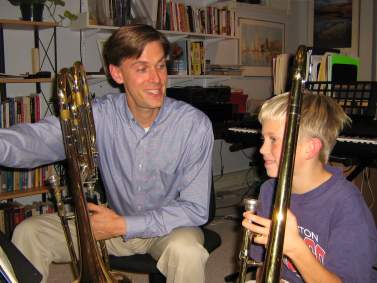
Kids deserve a teacher who makes the learning process exciting and enjoyable. Kids need a teacher who makes sure they develop habits that will serve them well as they progress on their instrument. Most important is that a young player experience a positive momentum, fueled by genuine improvement. An experienced teacher can nip bad habits in the bud very easily and effectively, and will lay the groundwork for continuing musical success. Learning an instrument is a serious endeavor, but there is plenty of room to have fun along the way!
Three Foundational Skill and Habit Areas
- Good playing technique
Good posture, deep breathing, a clear sound concept, and tonguing.
- Music reading
Students need to be fluent with note names, slide position/fingering, and rhythmic values. They must develop a strong sense of downbeat and upbeat, and learn to place rhythms on the "rhythmic grid" that the beat provides.
- A positive momentum fueled by genuine improvement.
This is created when a student masters quality, appropriate tasks in rapid succession, experiencing the "joy of becoming able". When these tasks are laddered correctly, the stage is set for continued progress, and educational dead ends are avoided.
Lesson Structure
- Conversation
I like to invest some time at the start of lessons in conversation, to get to know my students better, find out what is going on in their lives, and relax them. - Warm-ups and Basic Skill Building
Simple warm-ups help teach the building blocks of music, how the instrument works, and establish good habits. I use a lot of demonstration and imitation in this part of the lesson. - Assigned Material
This is the "body" of the lesson. Normally some music has been assigned with specific goals for improvement and the burden now shifts to the student to demonstrate what they have learned since the last lesson. The student's questions are answered and confusing topics are explained as simply and clearly as possible.
Feedback is given and any achievements are celebrated and recorded. When the student is having trouble, we go through the practice process together in order to master the problem and teach how to practice.
- Goal Setting
I like to be as specific as possible in setting goals for the next lesson and attempt to pick goals that are readily achievable. As time allows we play through any new music to get the ball rolling and clear up any misconceptions about the assignment.
- Model for Practice
The lesson becomes a model for the student's own practice sessions. The content of the lessons establishes what the student should be practicing at home, and the standard of quality and effort set in the lesson hopefully becomes an ideal for the student in practice.
Communication
Communication is the name of the game. If a private student doesn't understand what I have told them, then I need to explain it in a different way.
Some books that have been instrumental in developing my teaching style are:
- The Seven Habits of Highly Effective People, Stephen R. Covey. Simon & Schuster. ISBN 0-671-70863-5.
- How to Get Your Child to Practice Without Resorting to Violence!!, Cynthia Richards. Advance Publications. Available from Ithaca Talent Education (800-338-7483).
- How to Talk So Kids Will Listen & Listen So Kids Will Talk, Adele and Faber and Elaine Mazlish. Avon Books, 1999.
- What to Say to Get What You Want, Sam Deep and Lyle Sussman. Addison-Wesley. ISBN 0-201-57712-7.
Some of the key principles of communication from these books are:
- Put first things first.
- Expect the best.
- Seek to understand then be understood. Listen before talking, think before acting.
- Get to the point.
- Change what they do, not who they are.
- Model the behavior you desire.
- Adapt your approach to the person.
- Provide for dignity and self-respect.
- Appeal to self-interest using natural rewards.
- Rejoice at success.
- Feel your losses with remorse not guilt.
- Think win/win--synergize.
- Sharpen the saw--take time out to improve yourself and your teaching methods.
- Be positive and enthusiastic.
- Use tension dissolvers.
Other
Here are some links to pages on this site that will help you get a good sense of what my teaching is like.
- Biography
- Student Success Stories
- Audio Sound files - hear recordings of my students
- My Top Ten Tips for Teaching Trombone
- See Handouts I have developed for my teaching
- Books that have influenced my teaching
- Also, please see the appropriate category on the links to the left.
To schedule a lesson, or if you have other questions about my teaching, please feel free to email me.